

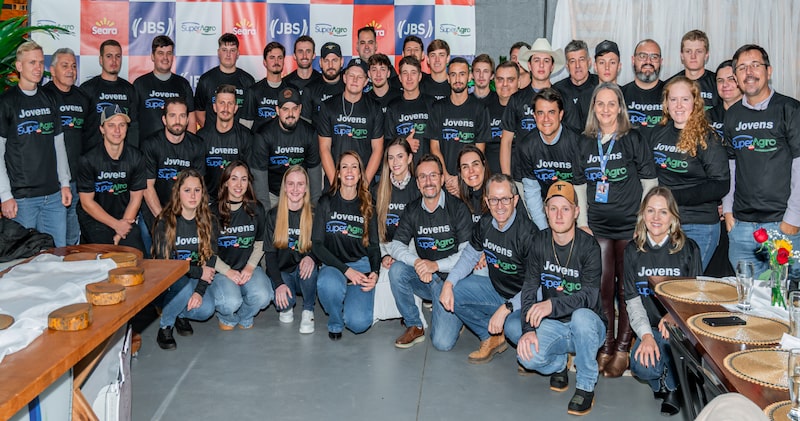
JBS, through Seara, is launching a groundbreaking youth entrepreneurship program focused on family succession in agribusiness. “Jovem SuperAgro” prepares farmers aged 18 to 30 to take over the management of farms integrated with Seara. The initiative aims at accelerating the development of a new generation of rural leaders who are more connected, efficient, and prepared for the challenges of modern agriculture.
“Family succession is one of the main challenges facing Brazilian agribusiness, and it often still occurs in a poorly structured manner, whether due to cultural factors or the difficulty of identifying the right moment when a young person is ready to take over management,” says José Antônio Ribas Junior, executive director of Agriculture and Livestock at Seara. “That is why we believe it is important to support this process by offering training and tools to ensure the continuity and strengthening of rural businesses.”
The training program lasts 18 months in a hybrid format, comprising nine modules developed by Seara in partnership with Sebrae in the states of Santa Catarina and Rio Grande do Sul. The topics covered include technology applied to agriculture and sustainability, as well as skills such as leadership, negotiation, communication, and self-awareness. Starting with the first module, parents and children participate in activities together, creating a synergy between the parents’ experience and the vision of the younger generations. Initially, the program will train 60 young producers.
“Nowadays, digital transformation makes it possible to monitor key production indicators via cell phone, even remotely, simplifying management and improving the producer’s quality of life. We want to show young people that rural farming can be highly technological, efficient, and profitable,” says Ribas.
For Maicon Toffoli, a 28-year-old pig farmer from Seara (state of Santa Catarina) and one of those selected for Jovem SuperAgro, the technological innovations presented in the program represent one of the greatest opportunities to make his farm more efficient and better prepared. “All knowledge translates into improvements for the farm. The business currently requires attention on several fronts, especially technology, since we work with increasingly automated processes. My hope is to gain knowledge that can be applied to the day-to-day operations of the farm and contribute to the growth and continuity of the family business,” he says.
His father, Larri Toffoli, sees the program as an opportunity to prepare the next generation for modern agribusiness. “It’s a very important initiative to ensure the farm’s continuity — an activity that has been part of our family for many years. As an only child, if he doesn’t carry on the work, we would have to look for alternatives,” he explains.
According to the latest Agricultural Census conducted by the Brazilian Institute of Geography and Statistics (IBGE), 77% of the approximately 5 million agricultural holdings are classified as family farms. This situation becomes even more relevant in light of the country’s demographic shifts: between 2010 and 2022, Brazil lost approximately 4.3 million residents in rural areas, underscoring the need for initiatives that encourage young people to stay in the countryside and take on leadership roles there.
In the state of Santa Catarina, for example, of the more than 321,000 registered active farmers, only one in 10 shows signs of family continuity in the countryside, with children already linked to rural activities in official records, according to a survey conducted by Sebrae-SC based on data from the Santa Catarina State Department of Finance (SEF/SC).
In this context, ensuring succession is essential for the continuity of production, income generation, and economic and social development. “In a scenario where retaining talent in rural areas is vital, investing in young people means more than just preparing successors: it means ensuring the continuity of a legacy built by farming families and strengthening the future of Brazilian agribusiness,” says Ribas.
