

A roundup of Friday’s stock market results from across the Americas
📉 A bad day for Latin American markets:
Latin American markets caught the negative wave from the US and the region’s main indices closed lower on Friday.
Chile’s IPSA (IPSA) closed with the sharpest losses in the region, with shares of non-basic consumer products, industry and raw materials posted the biggest losses.
According to economists Adriana Dupita and Felipe Hernandez of Bloomberg Economics, Chile is heading for its eleventh consecutive rate hike next week amid inflation that represents one of the biggest complications for President Gabriel Boric’s administration.
Despite the government’s efforts and central bank tightening cycles, they said, inflation is still far from returning to target, meaning monetary policymakers won’t be deviating from their hawkish stance any time soon.
Mexico’s S&P/BMV IPC (MEXBOL) was the second-worst performer during the session, closing 1.29% lower. The performance of the materials, consumer staples and industry sectors affected the index.
This Friday, a mission from the International Monetary Fund stated that after having registered growth in the first six months of the year, Mexico’s economy, the second largest in Latin America, will slow down its pace in the coming quarters.
Mexico is facing a difficult environment, as global inflation has soared. Although the recovery following the peak of the Covid-19 pandemic has been relatively gradual, inflation has accelerated to levels not seen in two decades, the mission said.
Argentina’s Merval (MERVAL) remained closed due to a holiday in the country.
🗽 On Wall Street:
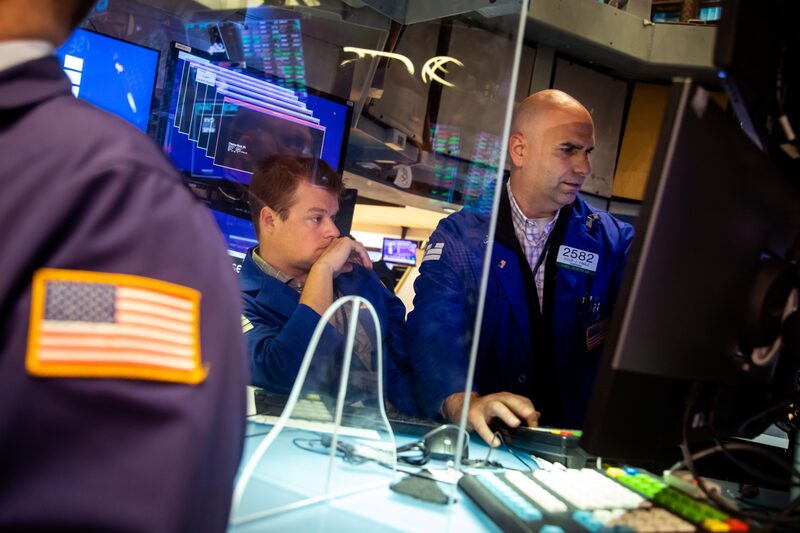
Wall Street got a reality check, with data showing a hot labor market that will likely keep the Federal Reserve on its aggressive hiking trail. Those bets sent stocks tumbling and drove 10-year US yields to their longest weekly up streak since 1984.
To David Donabedian at CIBC Private Wealth US, the report puts an “an exclamation point” on the idea that the market-bottoming process is going to be “a long one”. In this “bizarro world” of big hikes, traders may see the solid data as a reason to brace for turmoil, says Callie Cox of eToro. The conclusion for Brown Brothers Harriman’s Win Thin is that a 75-basis-point Fed boost in November is a “done deal,” with another increase of that size in December becoming a “real possibility.”
Almost 95% of the companies in the S&P 500 fell. The slide came just a few days after the gauge notched its biggest back-to-back rally since the onset of the pandemic amid a debate on whether the Fed would be closer to “peak hawkishness.” Those gains gave the measure its best week in a month even with the post-jobs plunge. The Nasdaq 100 sank nearly 4% Friday.
The S&P 500 sank 2.80%, the Dow Jones 2.11% and the Nasdaq Composite (CCMPDL) plummeted 3.80%.
Ten-year yields approached 3.9% amid their 10th consecutive weekly rise. The dollar advanced. The swap contract for the November Fed meeting priced in nearly 75 basis points of tightening. Market-implied expectations for where the rate will peak also increased, with the derivative contract for the March gathering trading around 4.66%. The current range for the benchmark rate stands between 3% and 3.25%.
Fed Bank of New York President John Williams said rates need to rise to around 4.5% over time, but the pace and ultimate peak of the tightening campaign will hinge on how the economy performs. Several officials, in separate remarks this week, delivered a resolutely hawkish message that price pressures remain elevated and they won’t be deterred from raising rates by volatility in financial markets.
Former Treasury Secretary Lawrence Summers said it’s important for the Fed to deliver on the further monetary tightening it has signaled, even in the face of financial risks stemming from its actions.
All eyes will now be on next week’s US inflation data after a hotter-than-expected reading in August tempered hopes of a nascent slowdown. Separately, minutes from the Fed’s September meeting will give clues into the central bank’s tolerance for economic pain.
Amid fears of a looming recession, investors poured the most money into cash since April 2020, but stocks could see further declines as they don’t fully reflect that risk, according to Bank of America Corp. strategists. Their report cited EPFR Global data showing cash funds received nearly $89 billion in the week through Oct. 5 -- while investors withdrew $3.3 billion from global stock funds.
Wall Street is “rebelling against” policy tightening, the strategists led by Michael Hartnett wrote before the labor-market report.
From a technical perspective, the fact that the S&P 500 remains oversold enough alongside bearish sentiment may warrant “more rally efforts” that could materialize as early as next week, according to Dan Wantrobski at Janney Montgomery Scott.
“The data being reported alongside our proprietary cycle work to date gives us confidence that we are on the right track in anticipating more of a ‘U’-shaped market bottom and recovery in the months ahead (into 2023),” he added. “We believe the floor will be established at some point in the weeks/months ahead -- but for now, investors should continue to expect a very choppy glide path due to significant macro overhang.”
For his part, Ronald Temple, managing director at Lazard Asset Management, said: “While job growth is slowing, the US economy remains far too hot for the Fed to achieve its inflation target. The path to a soft landing keeps getting more challenging. If there are any doves left on the FOMC, today’s report might have further thinned their ranks.”
On the currency markets, the Bloomberg Dollar Spot Index rose 0.4%, the euro fell 0.5% to $0.9739, the British pound fell 0.7% to $1.1080 and the Japanese yen fell 0.2% to 145.36 per dollar.
🔑 The day’s key events:
Oil on Friday posted its biggest weekly gain since March amid supply fears after the Organization of Petroleum Exporting Countries (OPEC) and its allies announced a production cut of two million barrels per day, their biggest decline since the start of the pandemic.
Russia also reiterated during the week that it will not sell its production to countries that adopt the U.S. proposed price cap, adding to supply uncertainty.
This week’s price rise is a turnaround for oil, which last week closed its worst quarter since 2020. West Texas Intermediate for November settlement settled at $92.64 per barrel, after rising more than 16% on the week. International benchmark Brent for December delivery closed at $98.21.
“Supply fears appear to be the driving force behind market action this week, leaving demand fears on the back burner for oil prices, even though they remain the focus of attention in equity markets,” analysts at wholesale fuels distributor TACenergy wrote in a note to clients.
🍝 For the dinner table debate:
Generation Z feels lost between new and old banking models. Also called ‘centennials’, young people between the ages of 12 and 26, are establishing their financial footing in an inflationary environment and face difficult decisions to achieve their financial goals.
Although about two-thirds of centennials actively save to achieve their financial goals, 85% said they had financial barriers. Members of Generation Z are more likely than other generations to combine financial ambition with a desire to live comfortably, says Bank of America’s global survey, Better Money Habits 2022.
Centennials don’t know the world without Google; they are digital natives with different consumer habits than previous generations, which presents a challenge especially for traditional institutions, according to the report.
-- Leidys Becerra, a content producer at Bloomberg Línea, and Rita Nazareth of Bloomberg News, contributed to this report.
